
Self-Guided Tour of Ohrid: 2026 Travel Guide
Ohrid is one of the most rewarding cities in the Balkans to explore on foot. Set beside the deep, exceptionally clear waters of Lake Ohrid, this historic North Macedonian town combines Byzantine churches, Ottoman lanes, lakeside promenades, traditional houses, lively cafés, and panoramic viewpoints. The compact old town is easy to navigate without a guide, yet every steep lane reveals another layer of history.
This Self-Guided Tour of Ohrid is designed for curious travelers who want freedom and context without being tied to a group schedule. I recommend allowing at least three hours for the core walking route, although a full day is better if you want to visit museums, swim in the lake, take a boat ride, and linger over a long Macedonian lunch. The route works especially well for couples, families with older children, photographers, history enthusiasts, and travelers connecting North Macedonia with Albania, Kosovo, or Montenegro.
For a ready-to-use route and additional practical details, see Balkan Destination’s Self-Guided Tour of Ohrid. This guide explains how to make the most of it in 2026.
Why take a self-guided tour of Ohrid?
A self-guided walk gives you the best balance between independence and discovery. Ohrid’s central sights are close together, but the town’s history is not always obvious from the outside. A church may stand on foundations from an earlier basilica, a quiet courtyard may conceal a Roman fragment, and a viewpoint may explain why Ohrid became such an important religious center.
Unlike a fixed group tour, you can start early, pause for coffee, take a detour to the waterfront, or spend an hour inside a church. You also avoid rushing through the old town during the hottest part of the afternoon. The route is economical: aside from modest entrance fees, you can experience the historic center with little expense.
Expect a mixture of paved streets, uneven stone lanes, stairs, and uphill sections. Comfortable shoes are essential. The route is manageable for most visitors, but some upper-town paths are difficult for wheelchairs and strollers.
Ohrid walking tour at a glance
- Starting point: Ohrid’s central square, commonly known as Kila Square or the square near the lakefront.
- Finish: Kaneo viewpoint and the lakeside promenade, with optional return through the old town.
- Core distance: Approximately 3.5 to 5 kilometers, depending on detours.
- Walking time: Two to three hours without long visits; four to six hours at a relaxed sightseeing pace.
- Difficulty: Easy to moderate, with cobblestones, stairs, and one sustained uphill section.
- Best time of day: Early morning for quiet streets or late afternoon for warm light over Lake Ohrid.
- Suggested budget: Around €15 to €35 per person excluding accommodation, depending on museum visits, meals, and boat trips.
Stop 1: Begin at Ohrid’s lakefront and central square
Start near the waterfront, where Ohrid immediately presents its most attractive feature: the relationship between town and lake. The promenade is broad, relaxed, and ideal for orientation. Look across the water toward the mountains and notice how clear the lake often appears near shore. Lake Ohrid is one of Europe’s oldest lakes, shared by North Macedonia and Albania, and its unusual ecosystem is a central part of the region’s identity.
From the square, take a few minutes to study the rhythm of daily life. Residents meet for coffee, families stroll beside the lake, and small boats depart for sightseeing trips. In summer, the waterfront becomes lively from late morning onward. If you are visiting in July or August, an early start makes the walk more comfortable and gives you better photographs without crowds.
Allow approximately 20 minutes here. A coffee usually costs about €1.50 to €3.50 in 2026, while a bottle of water is commonly €0.50 to €1.50 depending on where you buy it.
Stop 2: Visit the Church of St. Sophia
Continue uphill into the old town toward the Church of St. Sophia, one of Ohrid’s most significant religious monuments. The present building reflects centuries of construction and alteration, while its interior is celebrated for medieval frescoes. The church was an important ecclesiastical center and remains one of the essential stops on any Ohrid walking tour.
Inside, look carefully at the expressive faces, flowing robes, and layered colors of the frescoes. Photography rules can change, so follow the instructions posted at the entrance. Modest clothing is advisable because this remains a functioning sacred site, not simply a museum.
Entrance fees are generally modest, often around €2 to €4 per person, although prices and access can vary during religious services or restoration work. Plan 20 to 30 minutes for the visit. The surrounding streets are also worth exploring: traditional homes rise above narrow lanes, and small terraces provide attractive views over red roofs toward the lake.
Stop 3: Explore the Ancient Theatre of Ohrid
From St. Sophia, follow the old-town lanes toward the Ancient Theatre. Built during the Hellenistic period, the theatre is one of Ohrid’s most intriguing reminders that the city’s story began long before the medieval era. Only part of the original structure survives, but the setting is remarkably atmospheric, framed by stone walls and the upper town.
The theatre has also been used for modern performances, particularly during Ohrid’s summer cultural events. Stand near the seating area and imagine how the natural slope once helped create a dramatic performance space. Even when the site is quiet, it is easy to understand why this location remains culturally important.
A visit normally takes 15 to 25 minutes. Depending on the season and current conservation arrangements, entry may be free or involve a small fee. Because the stone surfaces can be uneven, watch your footing, especially after rain.
Stop 4: Climb to Samuel’s Fortress
The uphill walk to Samuel’s Fortress is the most physically demanding part of this self-guided route, but the reward is one of Ohrid’s finest panoramas. The fortress occupies the highest point of the old town and is associated with the medieval ruler Samuel of Bulgaria, whose realm had Ohrid as an important political center around the turn of the eleventh century.
Today, the surviving walls and towers offer a broad view over the old town, lake, surrounding hills, and distant mountains. The best time for photography is early morning or the final hour before sunset. Midday can be bright and hot, and there is limited shade on the upper walls.
Allow 30 to 45 minutes, including the climb and time for photographs. A typical entrance fee may be approximately €2 to €4, but confirm locally because opening arrangements can change. Bring water, particularly from June through September. The route from the theatre generally takes 10 to 15 minutes uphill.
Stop 5: Discover Plaošnik and the Church of St. Clement
Descend or continue toward Plaošnik, an archaeological and spiritual complex on the wooded slope above Ohrid. The area is closely connected with St. Clement of Ohrid, one of the most important disciples of Saints Cyril and Methodius and a major figure in the development of Slavic literacy and Christian education.
The Church of St. Clement and St. Panteleimon stands at the heart of the complex. The present structure incorporates a long religious history, and archaeological remains around it show that this hill was occupied and used for worship across different periods. Plaošnik feels calmer than the central lanes, especially outside peak summer hours.
Spend 30 to 45 minutes here. The combination of trees, stone ruins, religious architecture, and open views makes it one of the most peaceful sections of the route. Bring a light layer in spring and autumn, because the hillside can feel cooler than the waterfront.
Stop 6: Walk down to Kaneo and the Church of St. John
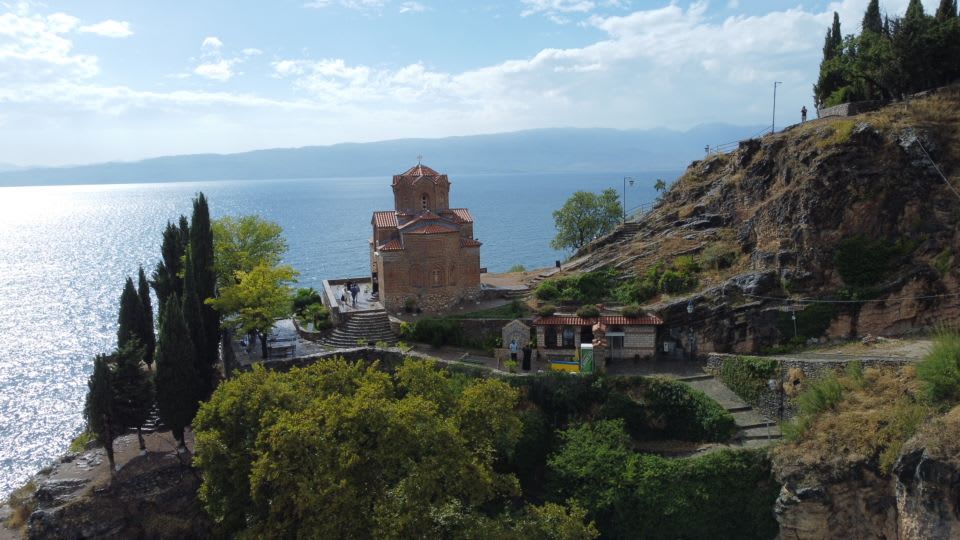
From Plaošnik, follow the path toward Kaneo. This is the image most associated with Ohrid: the small Church of St. John at Kaneo perched above the lake, with mountains and blue water behind it. The church’s exact origins are debated, but its medieval architecture and position make it one of the most photogenic landmarks in North Macedonia.
Arrive slowly rather than rushing directly to the viewpoint. The path includes steps and uneven sections, and several angles reveal different relationships between the church, cliff, and lake. Visit respectfully, as the church is a sacred place. If it is open, take a quiet moment inside; if not, the exterior and surrounding viewpoint are still memorable.
Plan 30 minutes for the church and viewpoints. In high season, visit before 9:30 a.m. or after 5 p.m. to avoid the largest crowds. Sunset can be beautiful, but return carefully because some paths become poorly lit after dark.
Stop 7: Return along the lakeside promenade
From Kaneo, walk along the lakeshore toward the town center. This section is ideal for slowing down after the uphill sights. Depending on the season and water conditions, you may see swimmers, small excursion boats, paddleboards, or people fishing from the shore.
Consider stopping for a swim if conditions are safe. Lake Ohrid’s water can be refreshing even in summer, and designated beach areas are preferable to unfamiliar rocky edges. A short boat trip is another popular addition. Prices vary according to route, boat size, and negotiation, but a short shared excursion may cost roughly €10 to €20 per person, while a private ride can be considerably more.
Finish with coffee, ice cream, or dinner near the waterfront. For a quieter meal, walk a few streets back from the busiest promenade. Local menus often include grilled meats, fresh salads, bean dishes, pastries, trout, and lake fish. Ask about the origin of fish before ordering, as conservation of Lake Ohrid’s ecosystem is important.
What to eat during your Ohrid visit
Food is an essential part of the experience. Try Ohrid-style trout where responsibly sourced and legally available, but also explore dishes that represent wider North Macedonian cuisine. Tavče gravče, a slow-baked bean dish, is filling and usually affordable. Ajvar, shopska salad, grilled vegetables, kebapi, and flaky pastries are easy to find. In summer, fresh fruit and cold yogurt-based dishes are particularly welcome.
A casual lunch usually costs around €6 to €12 per person, while a more substantial restaurant meal with drinks may cost €15 to €30. Prices rise on the prime waterfront, especially during July and August. I prefer eating one meal near the lake for the view and another in the old town for better value and a more local atmosphere.
Best time to take a self-guided tour of Ohrid
Spring: April to June
Spring brings mild walking temperatures, green hills, and fewer visitors. April can be changeable, so carry a waterproof layer. May and June are excellent for combining sightseeing with boat trips and outdoor cafés. Some seasonal businesses may not yet operate every day.
Summer: July and August
Summer offers the warmest weather and the fullest cultural calendar, but it is also the busiest and most expensive period. Start before breakfast, rest during the hottest hours, and continue after 5 p.m. Accommodation should be reserved well ahead, particularly for weekends.
Autumn: September and October
Early autumn is one of my favorite times for Ohrid. The lake remains pleasant, the light is soft, and the streets are less crowded. October can bring rain and cooler evenings, but the old town remains enjoyable for museums, churches, cafés, and photography.
Winter: November to March
Winter is quiet and atmospheric, with very few tourists. Some attractions may have reduced hours, and boat services can be limited. Pack warm, waterproof clothing and verify opening times before beginning the route.
Practical tips for independent travelers
- Cash: Carry Macedonian denars for small entrance fees, bakeries, public toilets, and local cafés. Cards are accepted in many hotels and restaurants, but not everywhere.
- Navigation: Download an offline map. The old town is compact, but lanes can be confusing and street signs are not always prominent.
- Clothing: Wear respectful clothing for churches and bring shoes with firm grip for cobblestones and steps.
- Water: Carry a reusable bottle. Summer walks involve more climbing than the map suggests.
- Safety: Ohrid is generally comfortable for visitors, but use normal precautions in crowded areas and avoid isolated upper-town paths late at night.
- Photography: The best light is early morning near Kaneo and late afternoon from Samuel’s Fortress. Protect cameras from strong sun and sudden lake spray on boat rides.
- Accessibility: The waterfront is relatively easy, while the historic upper town includes stairs and uneven surfaces. Travelers with limited mobility should plan a shorter lakeside itinerary.
How to reach Ohrid and combine it with the Balkans
Ohrid is well suited to a North Macedonia itinerary, but it can also be connected with neighboring countries. From Skopje, buses and private transfers are common, with the journey typically taking around three to four hours depending on traffic and stops. A private transfer is useful if you have luggage or want door-to-door flexibility; Balkan Destination offers Balkan Destination Transfers for regional travel planning.
Travelers beginning in Albania can reach Ohrid from Pogradec across the lake’s southern side or via road connections through the border. If you want to extend your trip beyond North Macedonia, consider a broader Balkan Explorer itinerary or a Western Balkans luxury discovery tour. These options can reduce the planning burden when combining North Macedonia with Albania, Kosovo, and Montenegro.
Ohrid also pairs naturally with a city stay in Skopje. After exploring the capital, you could continue independently or add the Skopje Walking Tour before traveling south. Visitors planning a wider Kosovo and Albania route may also compare the Kosovo and Albania Cultural Journey with an independent Ohrid extension.
Suggested one-day Ohrid itinerary
8:30 a.m.: Begin at the lakefront and central square while temperatures are comfortable. 9:00 a.m.: Walk to St. Sophia and explore the surrounding old-town lanes. 10:00 a.m.: Visit the Ancient Theatre. 10:45 a.m.: Climb to Samuel’s Fortress for panoramic views. 11:45 a.m.: Continue to Plaošnik and St. Clement’s Church. 12:45 p.m.: Walk to Kaneo and take photographs. 1:30 p.m.: Return along the lakeshore and enjoy lunch. 3:00 p.m.: Rest, swim, visit a museum, or take a boat trip. 6:00 p.m.: Repeat the lakeside walk in evening light and have dinner in the old town.
If you have only half a day, focus on St. Sophia, the Ancient Theatre, Samuel’s Fortress, Plaošnik, and Kaneo. If you have two days, reserve the second day for Lake Ohrid activities, the nearby monastery and viewpoints, swimming, and a slower exploration of local cafés and craft shops.
FAQ: Self-guided tour of Ohrid
How long does a self-guided tour of Ohrid take?
The main route takes approximately two to three hours if you walk continuously. Allow four to six hours for church interiors, fortress views, photographs, meals, and breaks. A full day is ideal during summer because you can avoid the midday heat.
Is Ohrid easy to explore without a guide?
Yes. The central sights are close together and the old town is generally safe and walkable. An offline map and a structured route are helpful because the upper streets include stairs and winding lanes. A self-guided format is especially convenient for travelers who prefer flexible timing.
How much does an Ohrid walking tour cost?
Walking the route itself is free. In 2026, budget approximately €15 to €35 per person for entrance fees, drinks, a casual meal, and optional small activities. Museum and monument prices can change, so check locally on the day of your visit.
What should I wear for visiting Ohrid churches?
Wear clothing that covers shoulders and knees when possible, particularly if you plan to enter religious sites. Comfortable walking shoes are more important than formal footwear because the route includes stone lanes, steps, and uphill paths.
When is the best month to visit Ohrid?
May, June, September, and early October offer an excellent balance of comfortable temperatures, open attractions, and fewer crowds than peak summer. July and August are best for swimming and festivals but require earlier starts and advance accommodation planning.
Plan your Ohrid experience
Ohrid rewards travelers who slow down. The most memorable moments are not limited to its famous landmarks: they include the sound of church bells above the lake, the reflection of mountains on calm water, a shaded old-town lane, and an unplanned coffee stop after a long climb. Use the route as a framework, then leave space for your own discoveries.
Ready to explore this historic lakeside city at your own pace? Start planning with Balkan Destination’s Self-Guided Tour of Ohrid and make your 2026 North Macedonia journey unforgettable.
Frequently Asked Questions
How long does a self-guided tour of Ohrid take?▼
The core walking route takes two to three hours, while a relaxed sightseeing day with church visits, meals, photographs, and a boat trip takes four to six hours.
Is Ohrid easy to explore without a guide?▼
Yes. Most major attractions are close together and the old town is walkable. Use an offline map and expect cobblestones, stairs, and uphill sections.
How much does an Ohrid walking tour cost?▼
The walking route itself is free. A realistic 2026 budget is approximately €15 to €35 per person for entrance fees, drinks, a casual meal, and optional activities.
When is the best time to visit Ohrid?▼
May, June, September, and early October offer pleasant weather and fewer crowds. July and August are ideal for swimming and festivals but are busier and more expensive.